
What makes a good pub for you?
Peter Reichert: Down-to-earth values, regionality, and friendly service. And a certain beer culture. After all, there's also a culture of glassware or tableware – and for me, that includes the way beer is poured and presented. It's not just about the product itself, but also about atmosphere and appreciation. That's why, at the Donisl, for example, we place great importance on beer from wooden kegs.
Furthermore, a good tavern needs a relaxed atmosphere. Guests should come in and immediately feel welcome. Above all, however, a tavern needs a soul. This is created by the people – by the landlords and the employees – but also by the space itself. In the Donisl, many personal items, collector's mugs, or instruments hang on the walls. This creates an ambience that appears to have grown and makes the history of the house palpable.
You have continued to develop the Donisl in recent years with formats such as „Tanz in Tracht“ and „Kulinarium“. Was this direction planned from the outset?
Franziska Kohlpaintner: No, not at all. It developed step by step. Peter took over the Donisl in 2021 – right in the middle of the Corona period. At that time, the main focus was on keeping the business running, finding employees, and creating a stable foundation in the first place.
Peter Reichert: At this stage, you don't immediately think about big event concepts. The first priority is to get through it.
Franziska Kohlpaintner: Everything else has actually developed very organically together with our guests. You sense over time which formats are accepted and how a house can continue to evolve.
With the „Kulinarium,“ you consciously tried to attract new target groups to the Donisl. What's behind the concept?
Franziska Kohlpaintner: We wanted to show that traditional pub cooking and fine dining don't have to be mutually exclusive. That's why we invite top chefs to the Donisl to develop menus with us. However, it's always important to us that the pub's DNA is preserved. Our aspiration is: sophisticated, but not pretentious. We don't want fussy food. It should always remain approachable and be a homage to Bavarian pub cuisine. At the same time, this has also allowed us to reach guests who perhaps haven't been to the Donisl for many years. Some tell us after an evening: „I would never have come in otherwise.“ And suddenly they rediscover the pub.
Fundamentally, every culinary experience is a source of inspiration for us. Even if we see a chip stand somewhere, we look around: Why are people queuing? What potatoes are they using? How does the concept work?
How do you define your target audience?
Franziska Kohlpaintner: That's actually not so easy to answer, because we have very different areas – from classic à la carte business to events, banquets, or our own event formats. Basically, however, the Donisl is aimed at guests who are interested in Bavarian tavern culture and want to experience it in a modern way.
Has the expectation changed in recent years?
Peter Reichert: Absolutely. People are more mindful about going out nowadays. It's no longer just about eating or drinking, but much more about the overall experience. Many people consciously want to take their time, experience something,.
Franziska Kohlpaintner: We're noticing how important real encounters have become. Hospitality is always a social place, too. Generations come together, exchange ideas and want to leave everyday life behind for a few hours.
Society is currently more focused on money. How can you still get guests excited about gastronomy?
Peter Reichert: People are more conscious today about what they spend their money on. Bavarian gastronomy isn't often that expensive in comparison. With us, for comparatively little money, you get a good meal with regional products and good service. That's honest value for money. And a tavern also has the advantage that you don't necessarily have to eat a large menu. You can just as easily pop in for a beer or a small bite.
How have guest dining and going-out habits changed in recent years, particularly during more economically challenging times?
Franziska Kohlpaintner: The catering industry continues to hold a high value for its customers. Today, it's much more about the overall experience. Many guests may go out less often, but they then consciously want to treat themselves to something nice. Catering doesn't just mean food and drink, but also socialising, a good pub atmosphere, and spending time together.
Der Donisl is located right in the centre of Munich's inner city – but it's slightly hidden away in a passageway. Does this location present any particular challenges?
Passageways are generally considered difficult – whether in retail or hospitality. Many don't even recognise from the outside what's hidden behind the Donisl.
Franziska Kohlpaintner: That's actually something we hear a lot. Many guests later say they are surprised by how large and atmospheric the inn feels inside. The location right on Marienplatz is still a big privilege, though. We're certainly at an advantage in many ways compared to a country inn.
How does deliveries work in the middle of the city centre?
Franziska Kohlpaintner: We are only allowed to receive deliveries between 6 and 10 am. That's why our day starts very early. Practically everything comes in during this period – meat, fish, vegetables, or drinks. We work with many regional suppliers. Meat from the Werdenfels and Murnau regions, or fish from Lake Walchen. For us, quality begins with purchasing.
Regionality generally plays a big role for you. How central is this aspect for guests today?
Peter Reichert: The sourcing of ingredients plays an enormous role, particularly in Bavarian cuisine. Even the best chef is useless if the quality of the meat isn't right. This is why we are very careful about which producers we work with.
The hospitality sector has been struggling with a shortage of skilled workers for years. How do you experience this in your day-to-day work?
Finding good employees has become significantly harder. However, this affects all industries – not just the hospitality sector.
Franziska Kohlpaintner: It is all the more important today to create a good working environment. If processes run smoothly and employees have their minds free, people also enjoy working in the hospitality industry. A chef is in a bad mood if equipment doesn't work or crucial ingredients are missing. a waiter is in a bad mood if the till breaks down or the beer is warm. In the end, it's about employees being able to concentrate on their actual job – being a host.
Alongside the Donisl, you also run the Bräurosl at the Munich Oktoberfest. How different are these two worlds?
A day at the Wiesn is basically like a week – sometimes even like an entire month – of normal operations. The dynamic is completely different, and a lot happens at a much faster pace. At the Wiesn, you have to react within the shortest possible time. If something breaks down there, you can't say, „The technician will be here next week.“ A solution has to be found immediately.
Peter Reichert: There are around 50 people working at the Donisl, and about 500 at the Wiesn. Around 240 staff members alone are in service.
How long does the preparation for Oktoberfest take?
Franziska Kohlpaintner: Actually, the planning starts during Oktoberfest itself. Many things are analysed directly or discussed for the following year. And then the saying holds true: after Oktoberfest is before Oktoberfest. First, there's the complete dismantling and follow-up work. It only truly gets quiet briefly in December – and afterwards, the planning starts all over again.
The 'Wiesn' has also changed in terms of food. What role do vegetarian dishes play today?
Franziska Kohlpaintner: A significantly larger one than just a few years ago. Originally, there were only roast chicken at Oktoberfest, but that has changed over the many years. Even though Wiesnhendl is still the most popular Wiesn food, guests expect much more variety, including vegetarian or vegan options. Especially in this area, an incredible amount changes every year. We also constantly try out new things and see what guests respond well to.
Guests no longer just want to eat a goat's cheese salad, but also want something truly substantial on their plate that's vegetarian, to have a good foundation for their visit to the marquee.
Both with Donisl and Bräurosl, you give very personal behind-the-scenes insights on Instagram. How indispensable is it today for a hospitality business to also build a personal brand?
Franziska Kohlpaintner: A very big role. However, we have learned that authenticity is more important than perfection. Spontaneous, genuine insights usually work better than completely staged content. We've also worked with agencies from time to time, but we've often moved away from them. Professional shots often don't work as well as an honest look behind the scenes.
If you could look into a crystal ball: where will the Donisl and the Bräurosl be in 20 years?
Franziska Kohlpaintner: Luckily, we can't look into a crystal ball. That's precisely what makes the hospitality industry so exciting. You never know exactly how needs will change. The sector is constantly in flux.
Peter Reichert: However, I do believe that events and banquets will become even more important in the future. This is considerably more predictable than the classic à la carte business. At the same time, this trust has to be earned over years. When someone is planning a company event or a big birthday, they want to be sure that everything will work.
Franziska Kohlpaintner: Personal contact will always remain crucial. People today are looking for places that seem authentic and where they can truly feel comfortable. And in the end, the foundation always remains the same: food, drink, and people. If these three things come together, a pub will also work.
About the person:
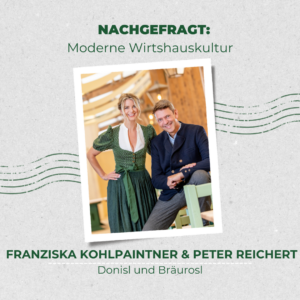
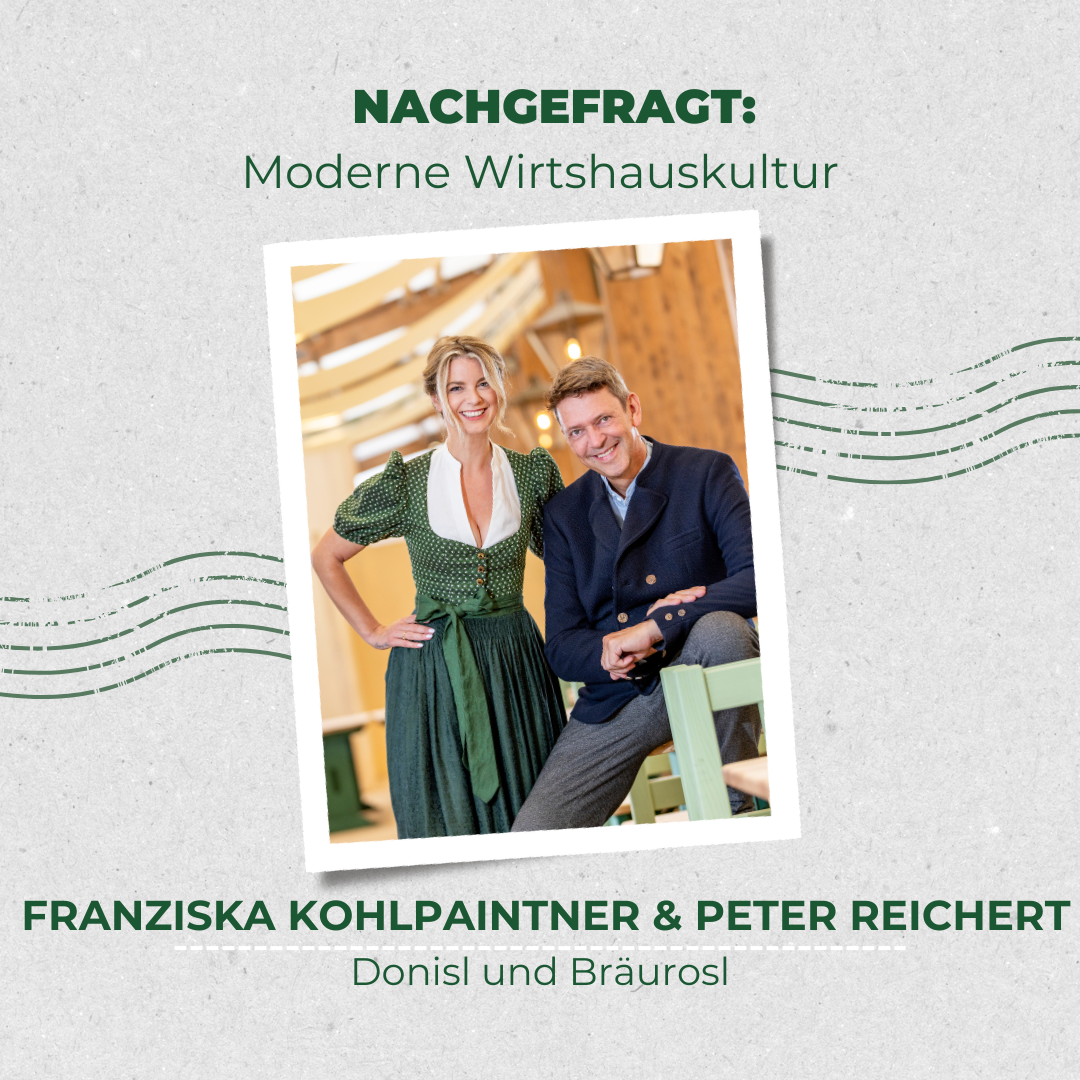
Peter Reichert and Franziska Kohlpaintner jointly run the traditional Munich inn Donisl at Marienplatz as well as the Oktoberfest tent Bräurosl. Even before taking over the Donisl in 2021, Reichert had made a name for himself as a restaurateur – including as the operator of the Hotel and Gasthof Seehof in Herrsching am Ammersee, and as the landlord of the tent „Zur Schönheitskönigin“ at the Oidn Wiesn. He is also a passionate musician and is considered an experienced host with a close connection to Bavarian inn and Oktoberfest culture. Franziska Kohlpaintner, after many years of self-employment in the traditional costume industry, moved into her partner's businesses four years ago – without formal catering training, but with a distinct service mentality and a clear guest perspective.