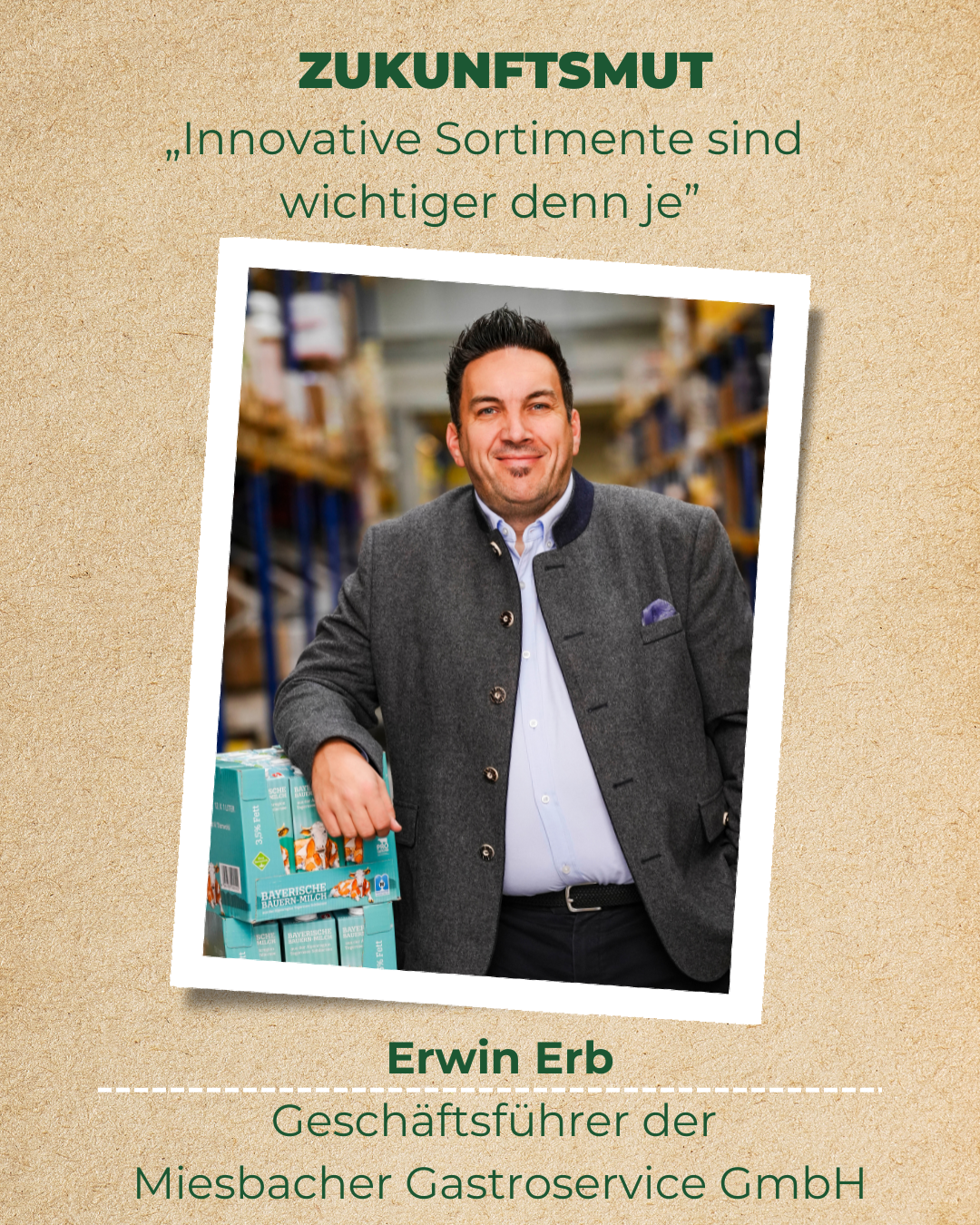
Constantly rethinking one's own concepts and the existing product range - these are two important success factors for Erwin Erb.
In the interview, the managing director reveals Miesbacher Gastroservice GmbH furthermore, what currently excites him about the industry, what innovations he sees and what makes him optimistic. Curtain up for part three of our series „Courage for the Future“.
Mr Erb, what is currently exciting you most about your industry?
The hospitality industry is incredibly resilient. At a time of countless regulations, growing bureaucracy and a strained economic situation, it is proving that it defies many challenges and keeps on fighting. The corona crisis is a mere four years ago, having brought many to the verge of subsistence, and yet – or precisely because of this – our industry remains innovative. High adaptability is crucial. The speed of change within one's own business must be greater than that on the outside. I see this in many restaurateurs: they are questioning their concepts, developing their existing range further or turning out-of-home dining into a real experience. All of this constantly brings a breath of fresh air into the industry and makes it successful.
Which innovations do you think are essential?
Innovative product ranges are more important than ever. For me, this includes keeping an eye on current food trends such as histamine-free or low-lectin diets*. Long-term trends like veganism or high-protein are equally important, but one should constantly re-evaluate whether they truly suit one's own business. The same applies to AI: in my opinion, integrating this technology has its justification in many areas. I do not count our sector among them. Here, I see customer services involving real people continuing into the future, and the wholesale trade as the winner that consciously dispenses with chatbots and AI telephone services.
What can we learn from the current changes?
Those who remain flexible retain their internal rate of adaptation and can survive in the long term. This involves closing oneself off to nothing and being ready for anything – whether for the previously mentioned food trends or other developments in the industry.
What do you wish for the future of the industry?
It is quite clear that the hospitality industry will manage to continue to exist in all its diversity. That is my wish for every single business, but also beyond that. Because when restaurants close, other areas are equally affected – from suppliers to producers. My second wish is directed at the government: we urgently need more clarity regarding existing and upcoming regulations, such as the EU Packaging and Packaging Waste Regulation (PPWR) or the EU Deforestation Regulation (EUDR). Despite me and my staff taking part in numerous webinars, it is often still unclear to the team what actually needs to be done. Our queries to officially responsible contact persons can likewise frequently not be answered concretely. Nobody knows what is going on. Yet right now it would be important to burden importers with less bureaucracy.
What personally gives you hope for the future?
My team. We work on an equal footing, stand up for one another and master even challenging times – always with a smile on our faces. That gives me the confidence that we can continue to grow and prevail. Looking outwards also makes me optimistic: the many dedicated restaurateurs who bring our industry to life and continue to develop it give me genuine faith in the future.
Histamine is particularly present in matured, fermented or longer-stored products. In histamine intolerance, these foods can cause headaches or gastrointestinal symptoms.
Lectins are naturally occurring proteins found in plant-based foods that have been linked to the development of inflammation. Heating them partially inactivates them.